

Stablecoin.1
EDEBIT

EDEBIT Top Level Domain



EDEBIT
(Part of an IBM Partner Programme)
EDEBIT TLD Agentic AI Programme
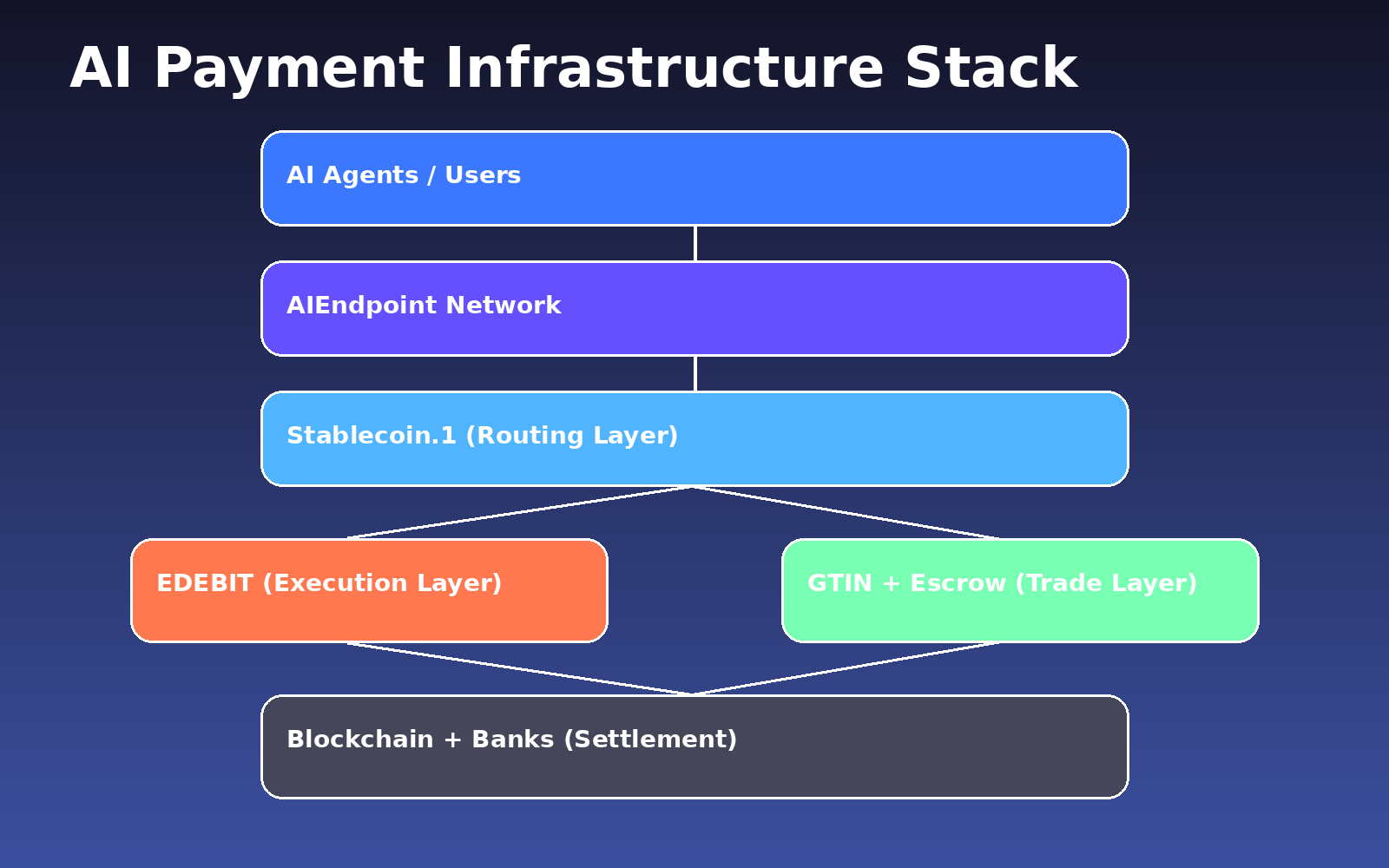
Routing Payments for The AI Endpoints Programme
Routing Payments for The AI Endpoints Programme
Overview
EDEBIT is a non-custodial payment abstraction layer that allows human-readable domain names to be used as payment identifiers, while actual settlement continues to occur on existing blockchain and traditional payment rails. EDEBIT improves usability.
Vision
“We are building the payment infrastructure layer for the AI economy.”The Problem
“Today’s payment systems were built for humans — not machines. AI agents will soon transact billions of times per day, but there is no system designed for that.”The Solution
How It Works
Why We Win
The Opportunity
This sits at the intersection of AI, stablecoins, and global payments — a trillion-dollar convergence.“Whoever owns the payment layer for AI, owns the infrastructure of the next internet.”
About EDEBIT
EDEBIT does not replace blockchains, wallets, or payment networks. Instead, it provides a resolution and routing layer that maps a domain name to one or more underlying payment endpoints, depending on context, currency, and user preference.
The system is designed to:
-
reduce user error and improve payment UX,
-
preserve user custody,
-
and remain compatible with existing infrastructure.
Core Design Principles
- Non-Custodial by Default
EDEBIT does not hold user funds and does not require custody of private keys.
Users retain full control of their wallets, accounts, and assets.
- Human-Readable Addressing
Domain names act as payment aliases, not wallets themselves.
The domain resolves to one or more destination endpoints (on-chain or off-chain).
- Rail-Agnostic Payments
EDEBIT does not mandate a single blockchain, token, or payment network.
It supports multi-rail routing, including:
-
blockchain networks,
-
stablecoin rails,
-
fiat on-ramps and off-ramps.
- Progressive Decentralization
The architecture supports decentralization where practical, while allowing centralized components where required for performance, compliance, or interoperability.
EDEBIT Token
The EDEBIT Token is backed by the EDEBIT TLD and other assets. View the EDEBIT Token Price and details HERE
Security
- Assumptions
EDEBIT assumes:
-
Users control private keys,
-
Blockchains provide settlement security,
- Protections
-
Cryptographic domain ownership
-
Signed resolver records
-
Optional hash anchoring on-chain
-
No centralized honeypots of funds
Because funds are never pooled, systemic risk is reduced.
- Wallet Compatibility
Wallets can integrate EDEBIT by:
-
resolving domains to standard addresses,
-
executing standard transactions,
-
without protocol-level changes.
Why Domains as Payment Identifiers?
Domains provide:
-
human readability,
-
global uniqueness,
-
portability across platforms,
-
brand alignment,
-
and long-term persistence.
EDEBIT uses domains as an abstraction layer, not as a replacement for existing payment infrastructure.
In Summary
EDEBIT is best understood as:
A domain-based payment resolution and routing layer that sits above existing payment rails, preserving custody while improving usability.
It does not attempt to replace:
-
wallets,
-
blockchains,
-
banks,
-
or payment processors.
Instead, it connects them through a consistent, human-readable interface that can evolve alongside both Web2 and Web3 ecosystems.